Last updated Jun 19, 2026

Managing business records is a major logistical challenge for organizations across the Washington D.C. metropolitan area. As commercial real estate prices climb and recordkeeping obligations remain complex, storing thousands of physical documents in a traditional office space may not be practical. Medical clinics, law firms, contractors, and local businesses can quickly run out of room to organize essential files.
For professionals operating in Prince George's County, offsite self storage can help free up expensive commercial square footage and keep boxed records in a more organized location. However, businesses with regulated documents still need to follow their own legal, compliance, insurance, and records-management requirements.
This guide explains what local businesses may want to consider when choosing storage for business records. We cover the impact of local climate on paper storage, the regulatory frameworks that influence retention planning, and how to estimate the amount of space your business may need.
Location and accessibility are critical factors when selecting a place to store business records. The commercial real estate landscape of Lanham occupies a useful position within Maryland. Positioned near the Capital Beltway (Interstate 495), the area gives local businesses access to major routes serving Prince George's County, Washington D.C., and surrounding communities.
A storage facility near commercial hubs like BECO Park at Forbes Center or Washington Business Park can offer a practical location for businesses that need to retrieve archived files without storing everything inside their main office.
The regional economy is profoundly anchored by major Maryland employers, federal research organizations, and military installations.
That makes organized recordkeeping especially important for many local businesses, including healthcare offices, legal practices, contractors, and administrative teams. Businesses in regulated fields should choose storage practices that fit their internal policies and applicable legal requirements.

When businesses move physical archives into storage, they should think carefully about access, organization, climate exposure, and security. Standard self storage is not the same as a managed records-storage service, but the right unit setup can help keep boxed files organized and easier to access when needed.
The state of Maryland experiences a humid subtropical climate. Hot, humid summers can be tough on paper-based records, especially when boxes are stored in garages, basements, or other spaces exposed to major temperature swings.
National preservation guidelines, such as those published by the National Archives, stipulate that documents must be stored in environments where the temperature is maintained strictly below 75 degrees Fahrenheit and the relative humidity is kept below 65%.
For everyday business storage, climate-controlled storage can help reduce exposure to temperature swings compared with non-climate-controlled environments. Businesses storing sensitive or legally significant documents should still use proper boxes, shelving, labeling systems, and professional records-management guidance where needed.
In the modern regulatory landscape, physical access to business records matters. Businesses should look for storage features that support controlled access and visibility around the facility.
SecureSpace Self Storage Lanham offers features such as digital video recording, an access gate, logged access, touchless computer-controlled access, and overnight surveillance. These features can support a more organized storage setup for business records, though businesses remain responsible for their own document-handling policies and compliance requirements.
Document retention is often shaped by state, federal, and industry-specific rules. Facility managers, office administrators, and compliance teams may need to retain files for years while still keeping them accessible when needed. Choosing an offsite storage unit can help reduce office clutter, but it does not replace legal or compliance advice.
The medical sector is bound by complex, intersecting retention laws. Under the Annotated Code of Maryland, medical providers must maintain patient medical records, laboratory reports, and X-ray reports for a minimum of seven years from the date the record was created.
HIPAA-related documentation may also have separate retention requirements. Medical offices should follow their own legal guidance for patient files, privacy documentation, and any records that contain protected health information.
The defense industrial base is undergoing a major regulatory shift with the implementation of the Cybersecurity Maturity Model Certification (CMMC) program. The CMMC framework provides increased assurance to the Department of Defense that contractors are protecting Federal Contract Information and Controlled Unclassified Information.
Contractors working with regulated information should consult their compliance teams before storing physical records offsite. A self storage unit can help with space and organization, but it should not be presented as a DoD-compliant records-management solution unless that specific service is separately verified.
The financial and legal services sectors face similar recordkeeping pressures. Businesses may need to preserve ledgers, agreements, client files, tax records, and other documents for defined periods depending on their industry and jurisdiction.
For these organizations, easy access to a storage location near major highways can be useful. Clear labeling, shelving, inventory logs, and internal check-out procedures can help businesses retrieve files efficiently when records are needed.
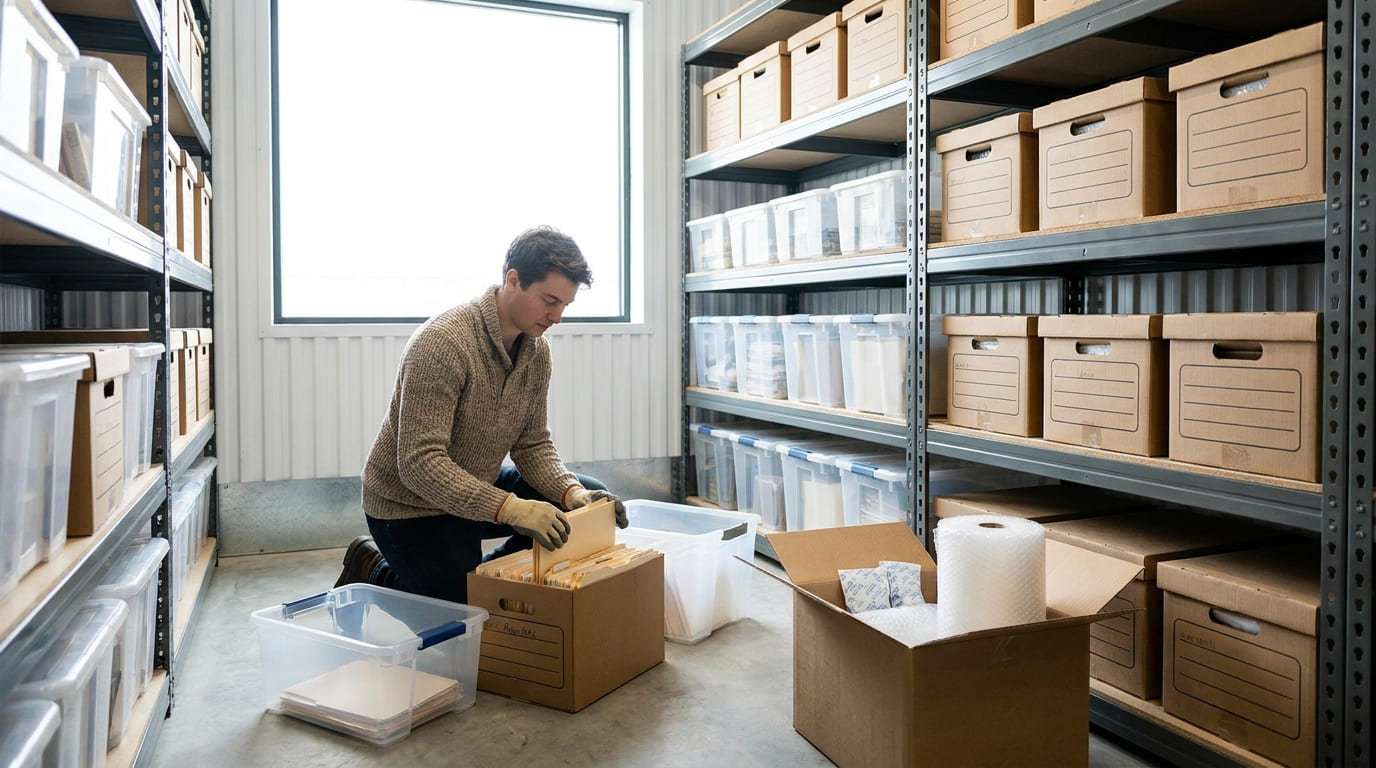
Office space in the Washington D.C. metropolitan area can be expensive. Using prime commercial real estate to house inactive file archives may not be the best use of space. Moving boxed records offsite can help businesses reclaim office square footage and create a more organized workflow.
One major point of friction for procurement officers is estimating capacity. It can be difficult to visualize how traditional office filing cabinets translate into storage units.
A standard 5x5 storage unit provides 25 square feet of floor space. Actual capacity depends on box size, shelving, stacking method, aisle space, and how often files need to be retrieved.
With careful organization, a 5x5 unit may work for a modest file archive or boxed records from a small office. For larger medical, legal, or business backfiles, available unit sizes such as 10x10, 10x15, 10x20, 10x25, or 10x30 may provide more room for shelving, walking space, and future growth.
Transitioning archives to storage should make daily operations easier, not more complicated. Businesses should look for practical amenities that help with moving and retrieval.
At SecureSpace Self Storage Lanham, available features include a covered loading area, loading dock, elevator access, carts and dollies, semi-truck accessibility, drive-up units, and month-to-month leases. These features can help businesses move boxes, supplies, and stored materials more efficiently, depending on unit availability and facility rules.
A document's lifecycle officially ends with secure, verified destruction. The Maryland Personal Information Protection Act mandates that any business processing the personal data of Maryland residents must implement reasonable safeguards to protect that data.
Businesses should use appropriate internal procedures or qualified third-party shredding and destruction providers for sensitive records. A storage unit can help organize records before they are destroyed, but secure shredding or verified destruction should be handled through a provider that offers those specific services.
Medical providers, clinics, and hospitals must retain patient medical records, laboratory reports, and X-ray reports for a minimum of seven years from the date the record was originally created. HIPAA-related documentation may have separate retention requirements, so medical offices should follow legal and compliance guidance for their specific records.
Climate-controlled storage can be helpful for business records because it may reduce exposure to temperature swings. For sensitive archives, historical records, or regulated documents, businesses should also use proper packing materials, shelving, and professional records-management practices.
A standard self storage unit should not be treated as a DoD-compliant records-management service by default. Defense contractors handling Federal Contract Information or Controlled Unclassified Information should consult their compliance teams and follow all applicable CMMC, contract, and internal security requirements.
Maryland law requires businesses to use reasonable safeguards for personal information, including proper disposal when records are no longer needed. Businesses should work with qualified shredding or secure destruction providers when disposing of sensitive employee, customer, financial, medical, or legal records.
Don't let overflowing file cabinets drain your office space or make records harder to manage. For individuals and businesses in transition, self storage can offer flexibility, convenience, and room to organize boxed documents outside the workplace.
SecureSpace Self Storage Lanham offers climate-controlled storage, digital video recording, logged access, overnight surveillance, online payments, and flexible month-to-month leases. You can also use available loading features, carts, dollies, and elevator access to help move boxes in and out more efficiently.
Reclaim your office space and organize your records with SecureSpace Self Storage Lanham in Lanham, MD.
Explore document storage in Lanham, MD with SecureSpace.
Everything you need to store your belongings securely, on your schedule.
Visit us online