Last updated Jul 31, 2026
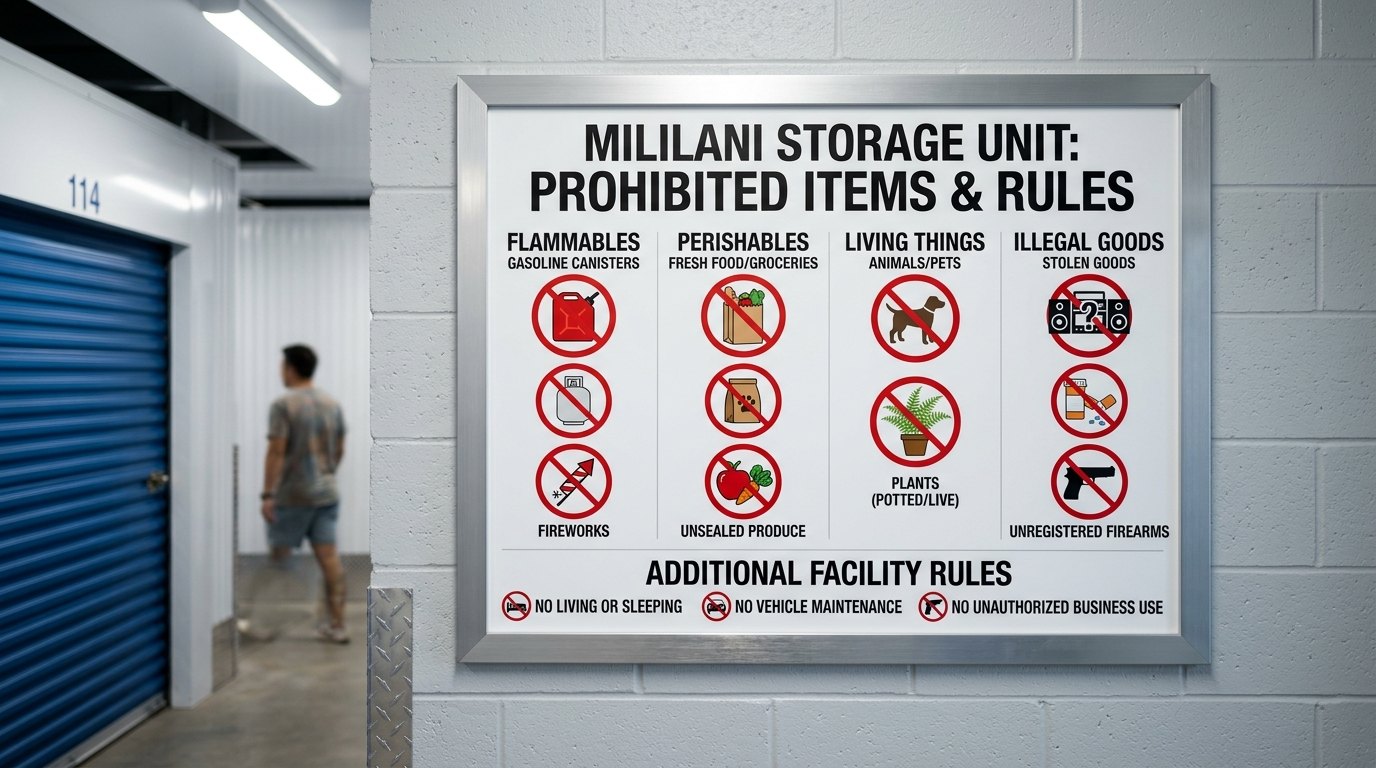
Knowing what belongs in a storage unit is only half the planning process. Before moving in, renters also need to understand which materials, activities, and belongings may be restricted by the rental agreement.
Mililani residents may face additional planning considerations, including strict Mililani Town Association (MTA) covenants that apply to certain properties and military moves connected to nearby installations. Association requirements vary by neighborhood and property, while storage restrictions depend on the facility's current lease and policies.
This guide covers common self-storage restrictions, but it is not a substitute for reviewing the rental agreement. When an item is not clearly addressed, contact SecureSpace Self Storage Mililani before bringing it to the property.
Storage units are not designed to function as residences, workshops, kitchens, or hazardous-material storage areas. Restrictions help reduce fire risks, leaks, odors, pest activity, and conditions that could affect neighboring units.
Online weather summaries sometimes reduce local conditions to a single figure, such as the statement that Mililani's climate averages around 78°F and 78% relative humidity year-round. Actual temperatures and moisture conditions vary by season, time of day, location, and weather pattern, so general climate data should not be treated as a prediction of conditions inside a particular unit.
Hazardous, combustible, or pressurized products are commonly prohibited or tightly restricted in self-storage facilities.
Examples may include:
Gasoline, diesel, and other fuels
Propane or butane cylinders
Acetylene and other compressed gases
Fireworks and explosives
Paint thinner and certain solvents
Corrosive chemicals
Some pesticides and fertilizers
Pool chemicals
Flammable cleaning products
Leaking containers or equipment
A product that is sold for household use is not automatically appropriate for an enclosed storage unit. Review the product label and rental agreement before storing chemicals, aerosols, batteries, or pressurized containers.
Lawnmowers, generators, motorcycles, recreational vehicles, and other motorized equipment may require special preparation.
Requirements can vary and may address:
Fuel levels
Fluid leaks
Battery condition
Registration or insurance
Vehicle operability
Unit dimensions and door clearance
Facility documentation
Do not assume that every engine must be prepared in the same way. Ask the facility for its current written requirements before transporting motorized equipment to the property.
Ammunition, explosives, fireworks, and similar materials are commonly prohibited because they can create serious fire and safety risks.
Firearm rules require separate consideration. Whether a firearm may be stored can depend on:
The facility's written policy
Current Hawaii law
The type and condition of the firearm
Ammunition storage
Required locking or security measures
Transportation and possession requirements
Do not rely on general online guidance to determine whether firearm storage is lawful or permitted. Confirm the facility's policy and follow all applicable laws before bringing a firearm onto the property.
Military personnel should also review current household-goods and installation guidance when preparing for a PCS move.
Scuba tanks and other compressed-gas cylinders may be restricted even when the rest of the associated equipment is acceptable.
A storage facility may treat a charged cylinder differently from an empty or professionally prepared tank. Before moving diving equipment into a unit, ask specifically about:
Pressurized cylinders
Empty tanks
Regulators and buoyancy compensators
Batteries or electronic diving equipment
Cleaning and drying requirements
Wetsuits, fins, masks, and similar equipment should be rinsed, cleaned, and completely dried before packing. Climate-controlled storage may help reduce exposure to temperature fluctuations, but it does not guarantee protection from moisture or material deterioration.
Food and other organic materials are often prohibited because odors and damaged packaging can attract insects or rodents.
Potentially restricted items may include:
Fresh or frozen food
Open food containers
Canned or packaged food
Meals Ready-to-Eat
Pet food
Livestock or poultry feed
Seeds and other edible agricultural products
Refrigerated or temperature-dependent products
Even shelf-stable products can leak, expire, or become damaged. Confirm the current policy before storing any food-related item.
Businesses should not assume that packaged inventory is permitted simply because it has a long shelf life. Food, cosmetics, supplements, and other regulated products may have separate storage requirements.
A storage unit cannot be used as a residence or sleeping area. It should also not be used as an office, storefront, workshop, or employee work area unless a facility expressly authorizes the activity.
Commonly prohibited uses include:
Sleeping or living in the unit
Keeping pets or other animals
Leaving living plants in storage
Meeting customers inside the unit
Manufacturing or assembling products
Cooking or preparing food
Operating power tools or machinery
Running extension cords or installing unauthorized electrical equipment
A unit may be suitable for permitted business inventory or equipment, but active business operations remain subject to the lease and applicable requirements.
Items that are illegal to possess cannot be stored in a unit. Restrictions may also apply to regulated materials or property requiring specialized handling.
Examples can include:
Stolen property
Illegal drugs
Contraband
Unlawfully possessed weapons
Hazardous waste
Biomedical waste
Unapproved chemicals
Materials requiring licensed storage
Property obtained through fraud or other illegal activity
Businesses and contractors remain responsible for licensing, disposal, transportation, environmental, and safety requirements. Renting a unit does not authorize storage that would otherwise be unlawful.
Some Mililani residents consider off-site storage because association rules may limit where certain vehicles can be kept at home.
For properties governed by the MTA, the MTA's Declaration of Covenants, Conditions and Restrictions (Article III, Section 3.02(p)) addresses boats, trailers, and truck campers kept on residential lots. The rule's applicability depends on the property and current governing documents.
Separate MTA guidance states that its interpretation of the boat-parking restriction was upheld by the First Circuit Court of Hawaii as recently as January 1998. Residents should review current documents or contact the association rather than assuming every Mililani property follows identical requirements.
SecureSpace Mililani lists RV storage, subject to current availability, dimensions, and facility rules. The location does not offer general outdoor parking, and boat or trailer storage should not be assumed.
Eligible indoor vehicle storage may also be possible in certain larger drive-up units. Before bringing a vehicle to the property, confirm:
Whether the vehicle type is accepted
Unit and door dimensions
Drive-up unit availability
Registration and insurance requirements
Fuel and fluid rules
Battery requirements
Vehicle condition requirements
Access and documentation procedures
Some belongings may not be expressly prohibited but still may not be appropriate for a standard storage unit.
Consider another storage method for:
Cash and negotiable securities
Critical original documents
Rare coins
Extremely valuable jewelry
Irreplaceable family items
Property requiring specialized temperature or moisture conditions
Items excluded from insurance or protection coverage
Essential medication or medical devices
Anything needed during an emergency
Review the limits and exclusions of any applicable coverage before storing high-value property.
Climate-controlled units are available at SecureSpace Mililani and may help reduce exposure to temperature fluctuations.
Climate control should not be interpreted as guaranteed humidity regulation, dehumidification, or protection against:
Mold or mildew
Rust or corrosion
Warping
Fading
Pests
Leaks
Packaging failure
Existing item damage
Clean and dry belongings before move-in. Use suitable containers, remove batteries when practical, and follow manufacturer guidance for electronics, furniture, tools, and recreational equipment.
Before loading a truck, review the rental agreement and create a list of anything that may require clarification.
Ask the facility about:
Hazardous-material restrictions
Food and organic products
Firearms and ammunition
Pressurized cylinders
Business inventory
Motorized equipment
Vehicles and RVs
Batteries and electronics
Delivery procedures
Insurance or coverage requirements
Prohibited activities inside the unit
Keep written confirmation when the facility approves an item that is not clearly covered by the lease.
Pressurized cylinders may be prohibited or subject to special requirements.
Confirm the policy for both charged and empty scuba tanks before move-in. Other diving equipment should be clean and completely dry before storage.
Uniforms, equipment, and other permitted belongings may be suitable for storage, but the customer remains responsible for military accountability and care requirements.
Ammunition, explosives, hazardous materials, and restricted tactical items should not be assumed to be acceptable. Check both the rental agreement and applicable military guidance.
Boat and trailer storage are not established services at this location.
RV storage is listed, subject to current space dimensions, availability, and facility rules. Contact the facility before transporting any oversized vehicle or trailer to the property.
Do not assume that sealed or shelf-stable food is permitted.
MREs, canned goods, dry food, pet food, and animal feed may still be restricted because damaged packaging can create odors or attract pests. Review the current lease or ask the facility directly.
Consequences depend on the rental agreement, the item involved, and the circumstances.
A customer may be required to remove the item, and serious violations could result in account action, termination, cleanup charges, damage liability, or referral to the appropriate authorities.
No. Climate-controlled storage does not make hazardous, perishable, illegal, living, or otherwise prohibited items acceptable.
It may help reduce exposure to temperature fluctuations for permitted belongings, but proper preparation and compliance with the rental agreement remain necessary.
The most reliable prohibited-items list is the one in the current rental agreement. Check questionable belongings before move-in rather than discovering a restriction after arriving with a loaded vehicle.
SecureSpace Mililani offers month-to-month leases, climate-controlled and drive-up unit options, and daily gate access from 6:00 AM to 10:00 PM. Confirm the selected unit type and current storage requirements before bringing specialized equipment, business property, or a vehicle to the facility.
Everything you need to store your belongings securely, on your schedule.
Visit us online